


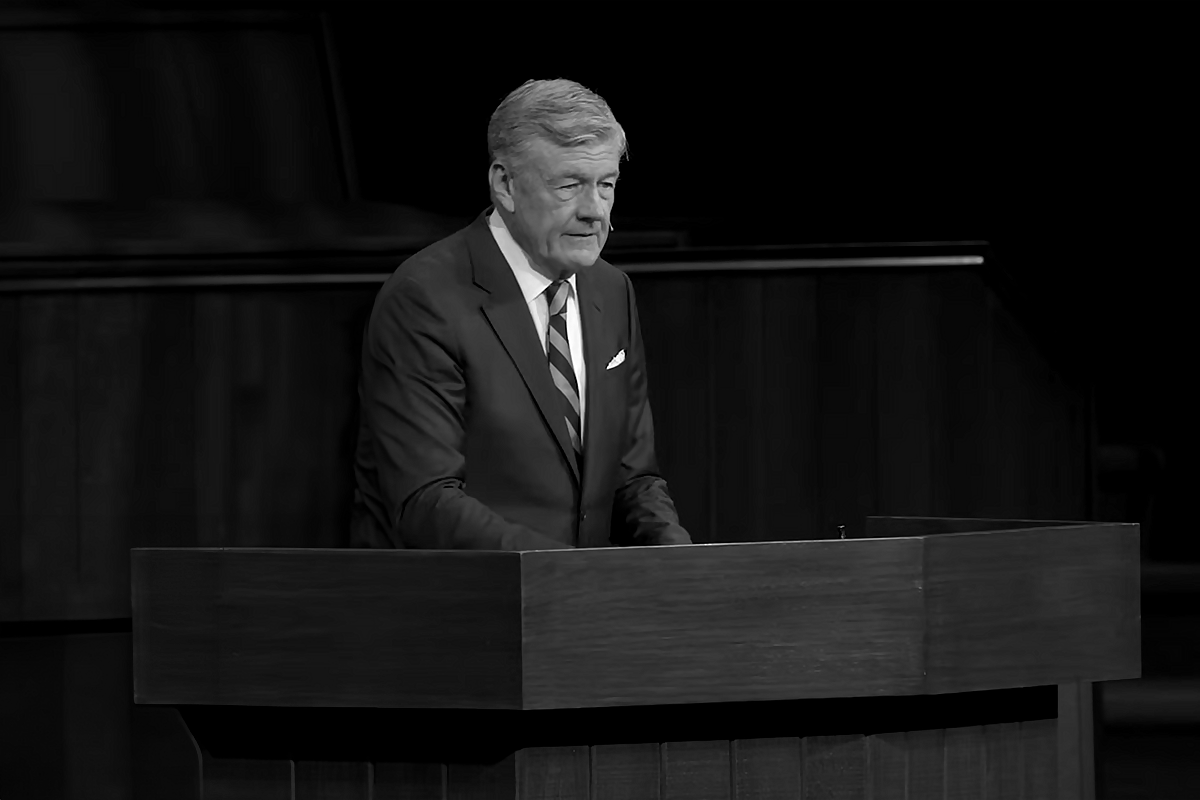
DALLAS, TX – Steven J. Lawson, a prominent leader in Reformed circles, has been removed from the pastorate at Trinity Baptist Church due to infidelity. The church did not make clear the nature of the relationship or the woman's identity. According to a statement released by the church, Lawson approached the elders with information regarding his inappropriate relationship.
“The elders at Trinity Bible Church of Dallas regretfully announce that effective immediately, Steven J. Lawson has been removed indefinitely from all ministry activities at Trinity Bible Church of Dallas. Several days ago, the elders at Trinity Bible Church of Dallas were informed by Steve Lawson of an inappropriate relationship that he has had with a woman. The elders have met with Steve and will continue to come alongside him and pray for him with the ultimate goal of his personal repentance. Steve will no longer be compensated by Trinity Bible Church of Dallas.”
Lawson’s ministry, One Passion, has also issued a statement,
“The board of OnePassion Ministries mournfully announces that just recently Steven J. Lawson confessed to the board that he has had an inappropriate relationship with a woman, a sin that has disqualified him from ministry. In response Steve has resigned from all his duties at OnePassion Ministries…Steve has confessed and regrets the damage he has caused to his family, the church, the reputation of OnePassion Ministries and most of all Jesus Christ.”
Lawson, 73, has served as a pastor for forty years and has written thirty-three books. Trinity Baptist Church appointed him as their lead preacher in the past few years. Lawson was a Teaching Fellow for Ligonier Ministries, where he also served on its board, and a Professor of Preaching at the Master’s Seminary, where he also served on its board and oversaw the Doctor of Ministry program. He has a wife and four children.
Origen would subscribe (maybe?)…
Ancient Christian answers for our culture’s deepest questions. Subscribe for a new article in your inbox every Monday.
Non-Christians have already begun to use Lawson’s sin to try to discredit Christianity. Some Christians have even taken advantage of the situation to attack his brand of Reformed Christianity. But most Christians have sorrowfully responded to the situation, realizing the influence of Lawson’s ministry and the pain it will cause his followers and those nearest him.

Lawson is hardly the first Christian leader to fall into sin, and Reformed Christianity is not the only tradition with sexually compromised shepherds. For example,
Vince Bantu, a prominent leader in Black church studies, was credibly accused this week of having a secret second marriage and supporting polygamy.
Evangelical apologist Ravi Zacharias had his ordination posthumously revoked after he was accused of extensive sexual exploitation.
Seraphim Storheim, the former Archbishop of Ottawa and Canada for the Orthodox Church in America, was defrocked after being convicted of sexually assaulting an underage boy.
Howard Hubbard, the former Roman Catholic Bishop of Albany, NY, admitted to covering up allegations of child sexual abuse by priests in his diocese. He reassigned the accused priests to other parishes to protect the reputation of the diocese.
All Christian traditions suffer from sinful leaders. We cannot logically attack a tradition’s theology based solely on the failings of its leaders unless we can directly and unquestionably connect its teachings to those misdeeds.
Unfortunately, sexual misconduct will continue to be an issue in the Church. Ministries should implement protections against such behavior, but as long as men are sinful, those not vigilant in guarding their hearts will still test any safeguards. And sexual misconduct is not the only temptation church leaders face. Financial misdeeds, overindulgence in food and drink, spiritually oppressive behaviors, and even abandonment of faith have brought numerous religious leaders to their downfall.
Most Christians will face the discouragement of watching someone they respect fall into grave sin at some point in their lives. These situations are emotionally overwhelming to navigate.
How should Christians react to a leader who commits a grave sin?
Accountability. Hold leaders accountable when they commit a grave sin. In the case of a serious sin, the minimum response should be removal from ministry. There must be no hesitation in involving the authorities for violations of the law. Leaders should not be shielded from consequences merely because they are leaders—doing so would be committing the sin of partiality.
Consequences for a shepherd’s moral failure should be even more severe because of their responsibility to lead the flock of God. The Church is commanded in Scripture to rebuke the grave sin of elders publically (1 Timothy 5:20). However, accountability does not mean unnecessary humiliation or mockery. Even in their sin, we must remember their dignity as someone made in the image of God—He desires to restore even their soul.
The Church should also keep the fallen leader spiritually accountable. Churches should seek the leader’s repentance and restoration into the flock of God (not to a leadership position). Often, the Church overlooks the restoration of a fallen leader because people tend to consider the sins of others, especially their leaders’ sins, as worse than their own. But Christians should never forget the depth of sin they would willingly indulge in if not for the grace of God. And yet, God seeks the lost sheep. Even when the sinner falls into a pit, God can still rescue him and set his feet on a solid rock.
In sorrow and love, through anger and pain, believers should pray for their fallen leaders, no matter how deep the depravity, begging God that they would repent and find forgiveness in the arms of the Savior.
Protection. Protect the vulnerable. If an innocent victim is involved in the scandal, their protection and healing are paramount. God places a prominent responsibility on His Church to care for the helpless. Shepherds protect the flock. The sin is especially grievous when a shepherd takes advantage of a sheep. In these cases, the Church must surround the victim with her love and tenderly nurse the abused sheep back to health.
Often, the innocent victims include the fallen leader’s family and congregation. Commonly, onlookers treat the family of the lapsed shepherd with a hushed sense of shame. The wife and children are often overlooked, left to suffer under the shadow of guilt cast by their husband or father, questioning whether the sin was their fault or if they could have done something to prevent it. Congregations also suffer greatly, and sheep may need proactive counseling to prevent them from stumbling in their faith.
The Church must learn from the sins of her shepherds and establish safeguards that encourage both leaders and members to pursue purity. The pain of today should be used to protect the potential victims of tomorrow.
Personal Reflection. Finally, the Lawson scandal should cause a moment of personal reflection. Seek purity. Remain humble. Remember that gifting does not equal godliness. Follow your leaders, but ultimately rely on God as a cure for wavering faith. And earnestly pray for those who minister to your soul—they are also sinners, and Satan would sift them like wheat given the opportunity.
Learn from Lawson. According to the public statements, he did one thing right—he exposed his sin to the elders of his church (James 5:20). The exposing of Lawson’s sin is ultimately beneficial, not just for the church but also for Lawson himself. Perhaps some readers are also harboring some secret sin, afraid of the consequences revealing it could cause. Isolation is the enemy of repentance. The first step to restoration with God is the confession of your sin.
For those who have a pure conscience before God, remain vigilant, “Your adversary the devil prowls around like a roaring lion, seeking someone to devour (1 Peter 5:8).” Bask in the innocence God has provided, but do not forget your proclivity for evil apart from His strength. As John Owen wrote, “Be killing sin, or sin will be killing you.”
There is nothing new under the sun. Humanity has always been weak. Leaders have gravely sinned before us—more are to come. Many mighty men have fallen—it must be our faith in God that steadies our souls, not our confidence in men. And before we judge others, even those who have fallen, let us examine ourselves. May we pray with Cassiodorus, a renowned Christian scholar and statesman of the sixth century, that God would bring Satan to sadness through our perseverance,
“Lord…Free us, Lover of men, from the danger which Paul mentions, that while preaching to others I may myself be found false. You truly know how weak we are; You recognise the nature of the foe who oppresses us. In our uneven contest and our mortal weakness we seek You, for the glory redounds to Your majesty if the roaring lion is overcome by the feeble sheep, if that most violent spirit who fell from heaven and is held subject here by Your warfare is overcome by the great weakness of our flesh. Then, even if through Your forbearance we suffer his power for a time, we shall certainly not be devoured by his insatiable jaws. Make him sad by reason of mankind’s joy, for he ever rejoices when we fail. Amen.”1
Cassiodorus, Cassiodorus: Explanation of the Psalms, ed. Walter J. Burghardt and Thomas Comerford Lawler, trans. P. G. Walsh, 53rd ed., vol. III, Ancient Christian Writers (New York; Mahwah, NJ: Paulist Press, 1991), 468–469.
Good word brother. I’m reminded that God had only once to work with a perfect specimen among men: the Lord Jesus Christ. I am pleased that in His divine forbearance, He is contented “to write His straight story with crooked sticks.” There is hope for us all. May God have mercy on Dr. Lawson and extra grace on those soiled by his sin.
A big Amen to that.
No one is beyond falling, King David for example.
Thankfully, none also is beyond repentance, redemption and restoration in Christ.
We again pray that this unfortunate incident will not become a stumbling block to the faith of others in Jesus' name. 🙏