


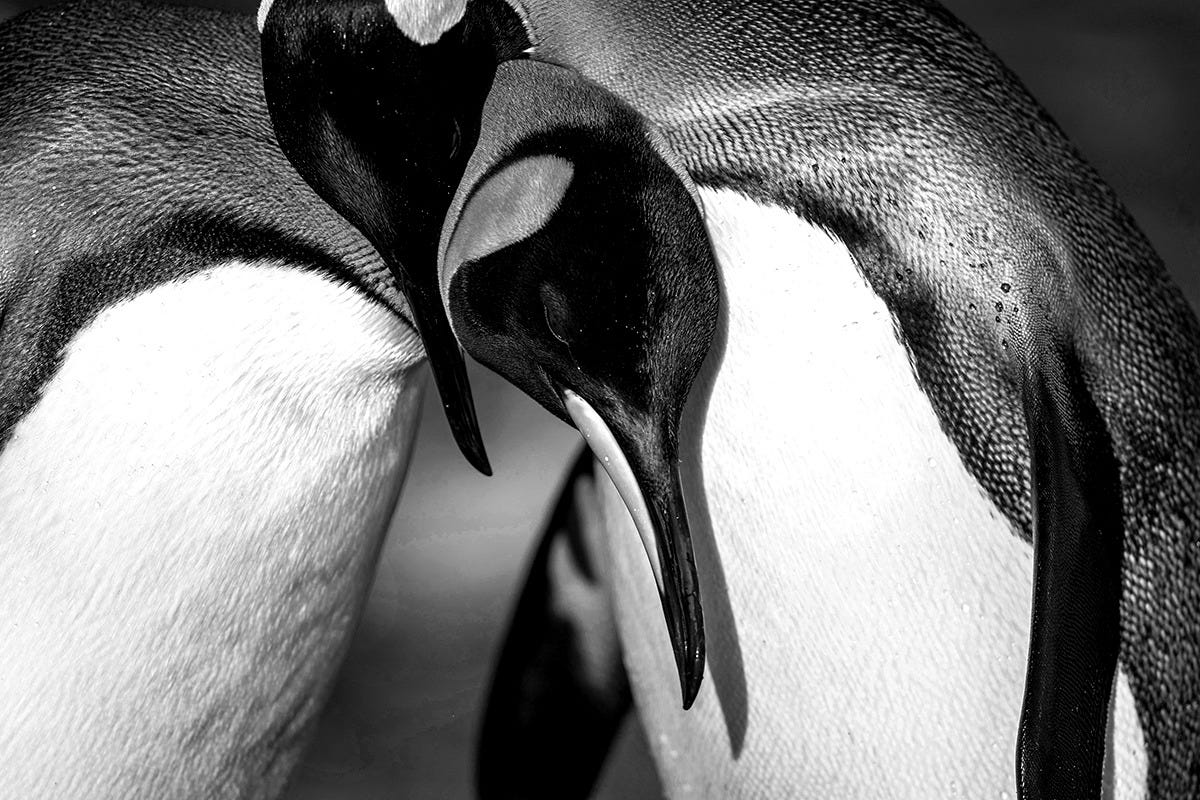
SYDNEY, AUSTRALIA – Sphen, a globally-loved penguin and icon in the queer community, has recently died at the age of 11. Sphen and another male gentoo penguin named Magic are internationally recognized for their unusual same-sex bond. The penguins met six years ago at Sydney’s Sea Life Aquarium, where they quickly paired up and began collecting pebbles for a future nest together.
The zookeepers provided the couple with a fake egg to avoid excluding them among the other penguins. When another couple neglected to tend their egg, the staff gave it to Sphen and Magic. They diligently protected their new egg until it hatched in 2018. According to Sea Life’s website, “Two weeks after our fabulous love birds, Sphen and Magic, became a viral sensation, we are so excited to announce that the same-sex couple [has] welcomed their fostered baby chick into the world!”
Staff brought Magic to see Sphen’s body upon his passing to mourn his loss. Upon seeing Sphen, Magic started singing. Soon, the rest of the penguin colony joined the dirge. Penguin keeper Renee Howell spoke of the occasion,
“It was a very beautiful moment, the air was just filled with their singing. It showed the impact [Sphen] had on his partner and that [Magic] actually recognized that his partner was there…We're not entirely sure exactly what was being said in these moments of singing, but it was definitely a beautiful moment to witness.”
Origen would subscribe (maybe?)…
Ancient Christian answers for our culture’s most profound questions. Subscribe for a new article in your inbox every Monday.
While Magic’s reaction is understandable, the media’s response is less so. Throughout the years, they have leveraged Sphen and Magic's bond to make a significant cultural impact, though in an unusual way. It is impossible to miss the implication in their articles—Homosexuality is normal because it sometimes occurs in the animal kingdom. In other words, sexual deviancy is animalistic, but in a good way. If the penguins are queer, why shouldn’t humans be?
News headlines throughout the years about the penguins have read:
“He said yes! Gay penguin proposes with 'special stone' and now couple are expecting their first egg hatching!”
“Australia’s gay penguin power couple adopts second chick.”
“Gay penguin ‘power couple’ Sphen and Magic celebrate milestone and maybe true love does exist.”
“Sphen The Gay Penguin Broke The Ice.”
“RIP Sphen: trailblazing gay penguin dies, leaving behind his lover Magic.”
Since their meeting, Sphen and Magic's story has had a significant impact far beyond what might be expected of ordinary penguins. They attended a Mardi Gras parade in Sydney to support the LGBTQ+ movement and have been featured in a Netflix series, documentaries, and children's books. Additionally, their story is included in the New South Wales Kindergarten curriculum to educate children about sexuality and consent.
Sphen and Magic are just one example of the media celebrating animals with sexually provocative behavior. This year, Peacock released a documentary called Queer Planet, aiming to broaden cultural views on human sexuality through animal behavior. The trailer showcases a montage of sexually peculiar animals as opposed to normal human sexuality. While these clips play, the narration reads,
“Our planet is home to over eleven million species. The paparazzi really are everywhere. Everything you were taught as a kid is wrong. Gay penguins, bisexual lions, sex-changing clownfish. This is a queer planet. Queerness has always existed. It's only in humans that we have such a stigma about it. The idea of just having two fixed sexes is clearly out of style. Mother Nature is pretty open-minded. Sex is not just for reproduction. It's clear that no matter where you look on our planet, nature is full of queer surprises. To be honest, we should all probably get laid a little more than we do.”
Anthropomorphizing animals is a common practice. Children often read stories and watch movies about animals who can talk, have jobs, and create loving families. These fantasies give animals human abilities and add an imaginary dignity to the animal. However, the anthropomorphism of Sphen and Magic does not raise the dignity of the penguins. Instead, it does the opposite and makes humans more like the beasts.
Looking to animals to determine how humans should behave and identify is morally deranged. While there are similarities between humans and animals, humans cannot simply pick and choose which behaviors from the animal kingdom to mimic based on a few shared traits. This logic leads to absolute moral degeneracy.
For example, humans and animals both receive nourishment through feeding. Some animals cannibalize their own. Why can’t humans eat each other? Humans and animals both have an instinct for reproduction. Some animals violently rape to fulfill this instinct. Should humans follow suit? And some animals are sexually deviant. “Well, the animals do it” just does not hold water as a legitimate reason for LGBTQ+ behavior and identity.
We encourage animalism and are shocked when society acts animalistic.
These arguments stem from a worldview that equates humans with animals. The atheist philosopher Daniel Dennett famously likened Darwinism to a “universal acid” that “eats through just about every traditional concept.” One example of this observation is Darwinism’s effect on man’s dignity. Darwin makes man no more than a highly evolved animal. Therefore, there is no reason why humans should not act or even identify as animals if they think it might fulfill their fleshly instincts.
Christianity is opposed to this secularist doctrine. While humans and animals are both formed from the breath of the same Creator, Christians teach that humans are fundamentally different than the animals—God created humans in his image. Each person's purpose is to embody the imago dei flawlessly—to be like God.
By rejecting their true purpose and believing they can become gods by their own means (not merely the images of God), humans may think they are exalting individual freedom, but they are deeply mistaken. Rather than finding liberty, they enslave themselves to their sinful instincts. Instead of becoming like God, they remake themselves into the image of the beast. Man finds freedom in reflecting the nature of God, not in following the example of lesser beings.
Any action that places our sinful passions above the nature God has given us is inherently animalistic. These actions are not limited to sexual deviancy, though these are perhaps the most prominent examples in our culture. Man is in a constant war with his fleshly appetites and is often swallowed by his many sensual desires—sexual deviance, yes, but also gluttony, slothfulness, wrath, envy, and more.
Central to Christianity is the idea that man cannot conquer his flesh alone. Man is pulled toward God by the imago dei within him. But he is also pulled towards the beasts by his sin. Man cannot reach the God of the heavens while his sin pulls him towards the pit of hell. God must descend for man to ascend.
Born shortly after the Council of Nicaea (AD 325), St. Basil of Caesarea defended orthodoxy against the two Christological extremes of Arianism and Apollinarism. He was one of the Cappadocian Fathers and is recognized as one of the Great Hierarchs in the Eastern Orthodox Church. In addition to his theological ministry, Basil was also renowned for his pastoral care of the poor and disadvantaged. Basil writes,
“Man, then, having been advanced above these things in honor, did not understand; and neglected to follow God and to become like his Creator, and, becoming a slave of the passions of the flesh, ‘He is compared to senseless beasts, and is become like to them’: now he is like an amorous horse which neighs after his neighbor’s wife, now like a ravenous wolf, lying in wait for strangers, but at another time, because of his deceit toward his brother, he makes himself like the villainous fox. Truly, there is excessive folly and beastlike lack of reason, that he, made according to the image of the Creator, neither perceives his own constitution from the beginning, nor even wishes to understand such great dispensations which were made for his sake, at least, to learn his own dignity from them, but that he is unmindful of the fact that, throwing aside the image of the heavenly, he has taken up the image of the earthly.
In order that he might not remain in sin, for his sake ‘The Word was made flesh, and dwelt among us,’ and He humbled Himself to such an extent as to become ‘obedient to death, even to death on a cross.’ If you are not mindful of your first origin, because of the price paid for you, accept at least some idea of your dignity; look at that which was given in exchange for you and realize your own worth. You were bought with the precious blood of Christ; do not become a slave of sin. Understand your own honor, in order that you may not be made like the senseless beasts.”1
Jesus alone redeems human nature and transforms it to be like God’s. People should look to Christ’s sacrifice, not to animals, for their example. Men must remember their true identity, as created by God, and lay their fleshly burdens at the foot of the cross. While the world pressures the culture to follow the penguins, society should unashamedly reject homosexuality, leaving it for the birds.
Basil of Caesarea, Exegetic Homilies, trans. Agnes Clare Way, vol. 46, The Fathers of the Church (Washington, DC: The Catholic University of America Press, 1963), 325–326.
I had to reread "New South Wales Kindergarten curriculum to educate children about sexuality and consent"
4 year olds?
New sub, enjoyed reading your post. 🙌