



Recently, Virgil Walker called out what he believes is a significant threat within Christianity: young pastors. I have been previously unacquainted with Virgil Walker. He seems like a passionate Reformed Baptist minister who sees real issues in American ministry culture and wants to solve them. But as a young man who has been involved in both church-planting and pastoral ministry, I obviously disagree.
Walker’s main critique is “We are ordaining boys, not men.” He goes on,
In broad evangelicalism, they come in skinny jeans—airy voices, soft edges, smiles like therapists. In conservative, Reformed circles, they show up as theology bros with beards—quoting the Puritans, cosplaying gravitas.
Different uniforms. Same weakness.
Men who can parse Greek, but you don’t get the sense they pray with their wives. Men who podcast about patriarchy, but show no heroic leadership at home. Men who thunder online, but whisper in their own living rooms.
Yes, we hand pulpits to boys and wonder why they fold when the real war comes… They make mountains out of molehills because they’ve never climbed a real one. No scars. No battles. Just scratches dressed up as stories of valor.
As to his most bold claim,
So let me ask it plainly: should a man even be considered for the office of pastor before the age of fifty?…
Fifty is not a magic number. But by then, a man has climbed real mountains. His children are older, maybe grown. His marriage has been tested. His faithfulness—or his failures—are visible in the rearview mirror of decades, not just months.
While Walker presents some truths in his article that should be considered, the main thrust of Walker’s article is misguided. It prescribes a poor solution based on false claims. And beyond being incorrect, his arguments, if heeded, would have a terrible impact on the Church both now and in the future.
At the very moment when the American Church is suffering from a pastoral shortage, young men are flocking back, hungry for purpose and meaning. Walker turns a gift from God into a double loss. His solution would deepen the shortage, denying certain of these men the very calling that, with real training and discipleship, could qualify them for the pastorate and fulfill the purpose for which they so passionately seek.
Walker’s article deserves a response.
The Good
Walker is correct on multiple points. For example, he is correct that neither degrees nor talents equal holiness. The Scriptural qualifications for bishops/elders do not include credentials or abilities beyond the capacity to teach. And as Walker emphasizes, being quarrelsome is disqualifying. Many men, both young AND old, struggle to meet this particular requirement, especially in their online conduct. Walker is also correct that Paul requires those with a family to rule their household well.
Origen would subscribe (maybe?)…
Ancient Christian answers for our culture’s most profound questions. Subscribe for regular articles in your inbox.
I don’t think anyone is advocating for a position where age or experience doesn’t matter at all. Sometimes, a novice is appointed when an ordination is rushed. Or, as he also rightly notes, some churches mistakenly choose a charismatic leader instead of a holy shepherd. This is an unfortunate reality.
Sometimes sheep can be manipulated to pick someone as a pastor who is not ready to be a pastor, someone who looks holy but isn’t. That makes sense; most of the time, the layman has never been a pastor himself. Even if one or two have been, this is far from the majority of the membership, who, in a congregationally-led church, will do the best they can in choosing a pastor (I promise I will restrain myself from discussing the very related benefits of an episcopal government here).
On these, and a few other points, Walker is correct.
The Bad
But Walker makes several grave mistakes. A noticeable one: The young cannot be qualified because they don’t have scars.
Yes, experience can often reveal a man's endurance. Scars have their place in the Church and should be honored, but scars are not included in the Biblical qualifications of a bishop/elder. In fact, scars can sometimes be detrimental to the flock when used to hide bitterness and apathy. Biblical qualifications, not scars, are essential—and they apply regardless of age or experience. Young pastors are not the only pastors who fall. While the Bible requires that the man “not [be] a novice,” it never demands that he have “scars” of a certain kind and intensity that meet Walker’s threshold.
Walker’s take on pastoral demeanor is confused. Young men are too gentle except when they are too quarrelsome. We should disallow young pastors due to this unavoidable catch-22. Instead, we should reduce the pastorate to older men who “roar truth,” not men who “massage tone.” After all, we wouldn’t want to disregard those pesky qualifications that emphasize gentleness at the expense of brashness: “not violent but gentle, not quarrelsome.” When older men “roar,” it is boldness and not quarrelsome, unlike when younger men do the same, and thus the older men escape this dangerous dichotomy.
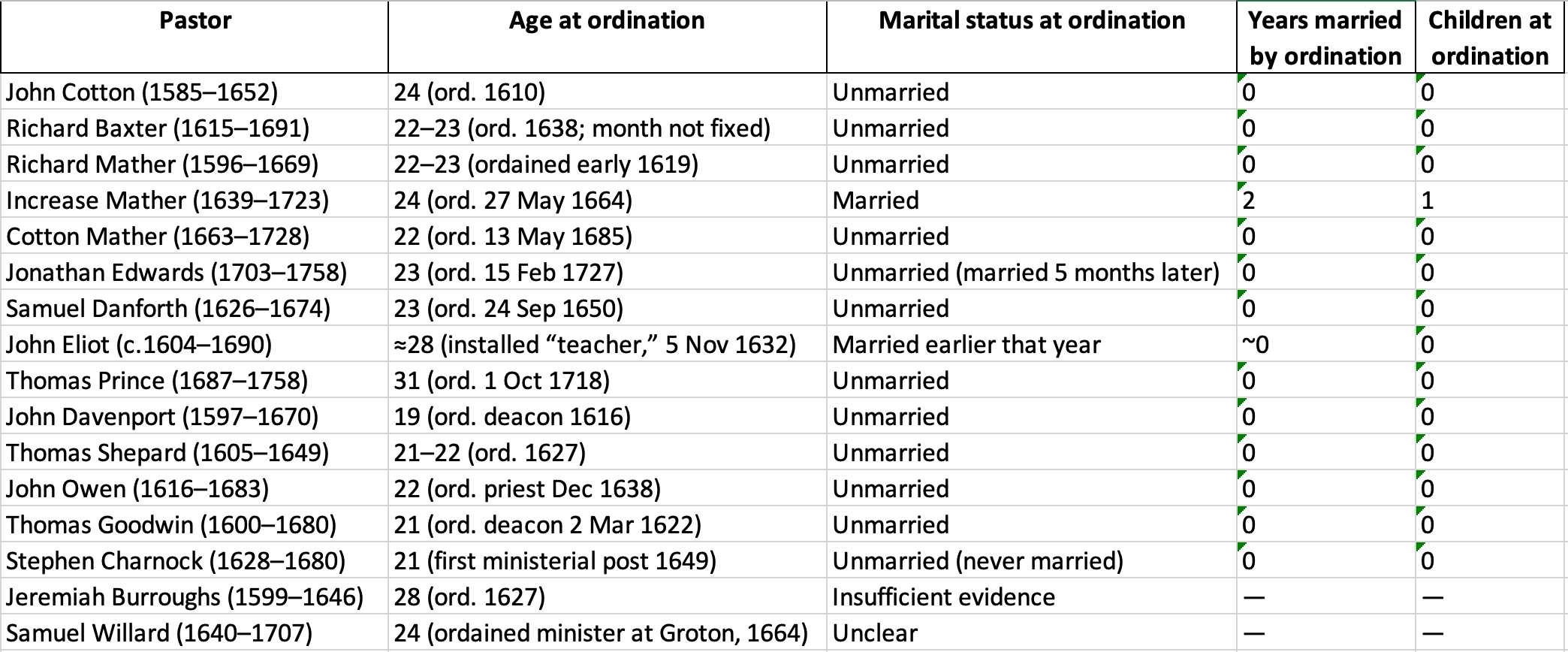
Of all Walker’s claims, the easiest to refute is the one about the Puritans: that they were against ordaining young men without thorough family experience. Walker states,
The Puritans would have called it madness. They expected a man to prove himself in the furnace of family before ever touching the pulpit. The hearth was his first pulpit. The table his first congregation. Family worship his first liturgy…
The Puritans expected a man to bleed in the trenches of family life before ever shepherding a congregation. Paul insisted a pastor must have children under his care—and under his authority. That means his family has been tested long enough to reveal his character.
But today? We ordain men in their twenties and early thirties. They’ve barely learned to lead themselves, much less a wife, much less children, much less a church. They may have a degree. They may have talent. But they have no scars.
That sounds good, almost poetic. But it’s just patently false. Besides the age of the minister in particular, marriage and children have never been universal requirements for pastoral ministry. Celibate ministry has brought eternal blessings to the Church and innumerable souls to heaven’s gates. The Puritans, while at times suspicious of unmarried ministers, were no exceptions to this rule.
The Ugly
Walker’s poor reading of the situation attaches two problematic additions to the Biblical qualifications: years and scars. These additional standards are in direct contradiction to Paul’s exhortation to the first bishop of Ephesus, Timothy, only a chapter after giving him the qualifications,
Let no one despise you for your youth, but set the believers an example in speech, in conduct, in love, in faith, in purity. Until I come, devote yourself to the public reading of Scripture, to exhortation, to teaching. Do not neglect the gift you have, which was given you by prophecy when the council of elders laid their hands on you. Practice these things, immerse yourself in them, so that all may see your progress. Keep a close watch on yourself and on the teaching. Persist in this, for by so doing you will save both yourself and your hearers. (1 Timothy 4:12-16)
Walker rightly identifies real Biblical issues in American Christianity, such as credentialism and performance eclipsing holiness and faithfulness. But he repeats the same error by imposing a narrow road Scripture never paves: marry, bear children, raise them to adulthood, and maybe when you’re fifty, you may finally be qualified for the pastorate. The Bible already sets a high bar. If some young men don’t meet it, the remedy isn’t extra rules; it’s enforcing the ones God gave, holding men to God’s standard, not ours.
Besides adding an unhelpful legalistic requirement, Walker’s opinion penalizes barrenness and even more notably, celibacy, a lifestyle God highly honors. Further, it overwhelms those with a genuine and holy desire for ministry with endless insecurity and helplessness.
Requiring a man to be fifty would have precluded Christ from ministry, and (unless my eyes deceive me) several men on the pastoral staff at Redeemer Bible Church, where Walker serves.
Requiring “scars” gives perverse incentives to those desiring to become a pastor to embellish those “scars” and “many years of service.” The emphases of the qualifications move away from Biblical character toward experience. This is a recipe for disaster.
Maybe I’m a simpleton, but I think we should stick with the Biblical qualifications over an unattainable standard. Stop infantilizing men and giving them more excuses to avoid pastoral ministry. Instead, set expectations for them to grow up and to do so quickly. Men become responsible when you give them responsibilities, not when you withhold their God-given duties.
A Better Solution
There may very well be a problem among young men in certain circles seeking ordination. But my inclination is that if there is such a problem, it is not simply the fault of the “young ones.” Surely, some of the guilt rests at the feet of the young men, but the older men in these circles must also shoulder much of the blame. Perhaps even most of it is theirs to claim because they created the cultural climate into which the new generation of ministers they trained now find themselves.
For my part, I rub shoulders with ministry men of all ages, and I am very encouraged by both the older and younger men in my limited circles. If Walker sees an issue with younger men in his circles, perhaps he should seek to guide them towards godly service and not restrict them from pastoral ministry for a mere want of birthdays.
The solution is clear. To the older men in the ministry, we need you. We need you to pour into us. To love and guide us. We need you to hold our feet to the fire when we do and say things in a less-than-pastoral way. Men thrive under a system of accountability and discipline, so keep us accountable. Pass on your experience, perhaps it will save us some of your scars.
Most young men I meet in ministry would kill for someone wise to come alongside them with fatherly advice. Older man, build a meaningful relationship, and then offer your guidance freely—it is your duty to younger ministers and the Church.
And young men, don’t let others despise your youth. Be an example. Serve God. Lovingly lead your family (if you have one). Study hard. Place yourself under the accountability of an older godly man—choose carefully. Study to show yourself approved, and do not procrastinate in the face of God’s calling. The need is urgent, and we, the Church, shouldn’t have to wait till you're fifty.
Teachability no matter what the generation you are in is key.
I respect Walker a lot and used to listen to a podcast of his through Covid times, but this article of his missed the mark. You gave a biblically sound and respectful response. Great work here!