

This summer, my family and I became Anglican. Some friends and family were surprised to learn, from our announcement, that we had seriously considered Roman Catholicism in our journey. Other Roman Catholic friends of mine were confused as to why I had not crossed the proverbial Tiber. Many of those close to me and some online have asked me to tell my story. Well, here it is.
First, I do not use “Roman” Catholic in a derogatory sense as some Roman Catholics claim Protestants do (some do). I use it to distinguish among the catholic traditions. Because I am not Roman Catholic, I do not believe that the Roman expression of the catholic faith is the only form of that faith, even while I recognize that the Roman expression is a valid form of the catholic faith.
And that is where my story starts. With the catholic faith. What does it mean to be catholic?
The Nicene Creed says, “We believe in one holy catholic and apostolic Church.” Catholic is best defined by St. Vincent of Lérins as the faith “believed everywhere, always, and by all.” In short, the catholic Church is the universal body across geography and time that has held to the same core tenets of Christianity. Where there is consensus on a belief, there is the basic foundation of catholic doctrine. Anyone who wishes to be called catholic should seek to align themselves with these consensual doctrines.
But why should I care to be called catholic?
At one time, I couldn’t have cared less. I was not familiar with the creedal tradition, let alone the concept of Church consensus. I had my Bible, and that was enough. Until it wasn’t. Actually, it’s not that the Bible wasn’t enough. It was that my intellect wasn’t enough. Let me explain.
The Bible is the fountainhead of all truth, but to understand it, we must use our flawed minds and make fallible judgments whenever we interpret Scripture. Though the Bible is wholly true and the final rule of faith and practice, how can I trust that I understood the truth it was trying to convey in the way God intended it to be understood? Like the rest of humanity, my brain is subject to misinterpreting Scripture due not only to my sinful nature, but also the bias I inherit from my background, culture, age, and personal circumstances.
While in college, I was confronted with a practical outworking of this problem, although I didn’t know it at the time, nor could I have put it into words like these. I had been taught by every one of my pastors, parents, mentors, and teachers that only a particular Bible version is acceptable for Christians in the English-speaking world. The Independent Fundamental Baptist (IFB) movement effectively made using the KJV a central dogma of belief.
Without a single doubt in my mind, from the time of my baptism until I graduated from college, I heard more preaching from pulpits and teaching from classes on the reliability of the KJV than concerning the Trinity or the nature of Christ.
When, in the last year of my undergraduate studies, I began to doubt that anyone’s conscience should be bound to using only the KJV, it did not end merely with a different understanding of Bible translations. Because I recognized that KJV-onlyism was a central tenet of the IFB, I realized I could no longer be a part of the IFB movement.
Unfortunately, some of my friends did not identify KJV-onlyism exclusively with the IFB, but with Christianity as a whole. Many of these kids had always been taught that the IFB was the preeminent form of Christianity. I know several who ultimately rejected Christianity after seeing the flaws in KJV-onlyism and other fundamentalist teachings. Because these teachings had been treated as central to “pure” Christian doctrine, leaving them felt like leaving true Christianity itself, and they concluded that the faith as a whole was not valid.
But when I left, I realized that Christianity was much larger than the IFB, and many of my long-held beliefs began to be confronted, not by theological liberalism, but by other orthodox Christian traditionalists who interpreted Scripture, often the same passages, differently than I had been taught. Sometimes, it seemed to me, with deep study, these other interpretations were incorrect. At other times, I was convinced they were undoubtedly correct. My doctrine evolved over several years following my undergraduate experience.
Reeling from the recognition that I had been taught incorrect interpretations on numerous topics that seemed to me so easily disproven, I had a moment of realization: how did I know I was right? Could not my interpretations be “easily disproven” by those whom I had left—using a methodology different from mine—or even by those who were merely more intelligent or better read than I?
Origen would subscribe (maybe?)…
Ancient Christian answers for our culture’s most profound questions. Subscribe for regular articles in your inbox.
I was interpreting Scripture the way I had always done, but the hermeneutic I had been given left me anxious and uncertain about the truth. I found that, rather than being centered on Scripture, my hermeneutic was centered on my ability to interpret Scripture, and not only to interpret Scripture, but also to determine for myself what constituted the most basic doctrines that defined Christianity as a whole.
In my experience, many in the IFB had decided, based on their understanding of Scripture, that certain doctrines (like KJV-onlyism) were central to the definition of Christianity. Who was I to say they were wrong? How could I rely solely on my own reason to prove the error of their doctrine when some in their camp were clearly more learned than I was?
Fundamentally, what made my reason better than theirs? What made my list of essential doctrines right and theirs wrong? To top it off, many of the men who taught me were undoubtedly more experienced and had walked with God longer and more deeply than I had.
This feeling of uncertainty was compounded by my seemingly ever-evolving understanding of doctrine. After thorough study, my soteriology developed: I rejected dispensationalism, set aside unconditional eternal security, and more. Over the course of seven years, my doctrine underwent continual changes as I discovered new ways in which I had been misinformed.
Yet even as I was changing, how could I know whether the direction of that change was right? I know many godly people in the IFB movement who still have my deepest respect. My dearest mentor, the man through whom God secured my desire to serve Him, was a staunch IFB teacher at my alma mater. Was I implicitly condemning him and others as “less spiritual” by departing from the doctrines they had taught me?
The uncertainty became tiring. Then overwhelming. The Bible is the source of all truth, but my reason was fallible. I heard Phillip’s echo ring from thousands of years ago, “Do you understand what you are reading?” I replied, “How can I, unless someone guides me?” (Acts 8:30-31). The Bible was enough. I wasn’t.
Then I was confronted with Roman Catholicism. While I recognized the weaknesses of my former tradition and was searching for truth, my uncertainty deepened when I realized that many things I’d been taught about Roman Catholicism were straw men. I would also learn that the misconceptions run deep on both sides.
Growing up, prayer to the saints, the Marian dogmas, purgatory, and other Roman Catholic doctrines were painted as extreme caricatures of what I would come to learn were well-thought-out positions that deserved real intellectual attention. When I was confronted with the steelman version of these arguments, I did not have the tools to respond immediately.
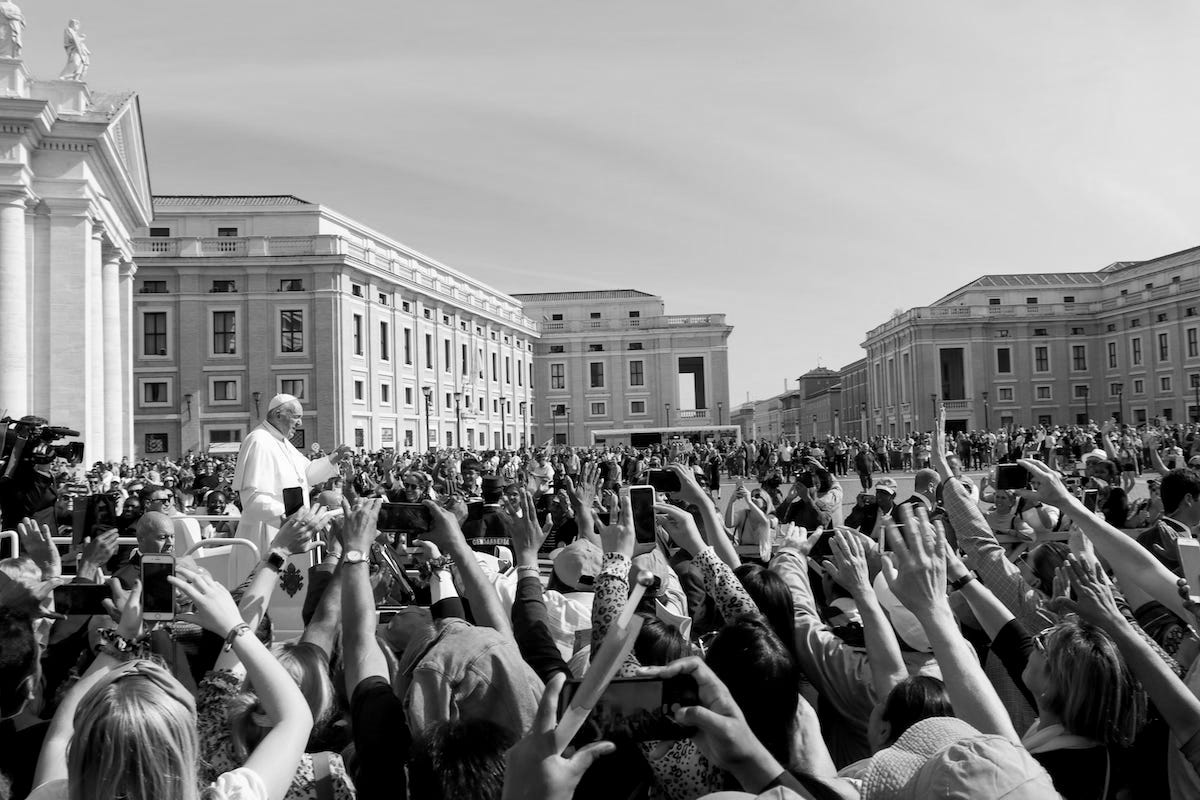
But forming opinions on these positions took a backseat for a time in the face of the papacy. To a theologically anxious mind, the papacy is Roman Catholicism's most attractive allure. It is also what defines Roman Catholicism among the Christian traditions. As I began to understand the Pope’s role within the Roman Catholic hermeneutic, I felt a forceful draw to Rome.
If Rome’s claims are right, what the papacy provides is of inestimable value many times over. The Pope truly acts as a father within the Roman Catholic Church. A son has no need to doubt his father’s words; he simply trusts and obeys them. Over time, he studies them more deeply and comes to a fuller understanding of his father’s wisdom and judgment. In his father’s house, away from the confusion of the outside world, a son may recognize his unbelief as a form of misunderstanding and choose to set it aside under the wisdom of his father.
If the papal claims were true, I would be willing to suspend my myriad objections to a host of other doctrines. If the Pope and magisterium define a dogma, I could be like that son who is happy to eat from his father’s hand. I would no longer need to struggle with the anxiety of whether I was right or wrong, at least on the essential topics. I would bypass the first and most anxiety-inducing step of theological inquiry: the question would no longer be which doctrines are true, but why those doctrines are true.
For several months, I struggled both mind and soul with severe doubt. Our lead pastor was on an extended leave for ministry training. In his absence, I was pastoring, working overtime at my secular job, preparing for my next semester at seminary, and parenting four exuberant children. My heart was breaking because I felt the weight of my struggle and knew that, were I to change, I would be disowned by many of my closest friends and family. My sleep and diet were heavily affected. Halfway through this period, while I was overseeing a visiting missions team for the week, my wife had a miscarriage.
Still, I studied. I read the Bible. I read the Church Fathers. Every extra moment, I researched the papacy. It was normal for me to stay up until 3 or 4 am, studying or discussing it with my wife, only to roll out of bed at 7:30 to get ready for work. Every drive, I listened to an audiobook or podcast. In my downtime during my job, I watched videos on every side of the issue (my job at the time allowed for this).
I realized that if the papacy was necessary to the definition of the Church, this was a matter of life and death, heaven and hell. I took Cyprian seriously when he wrote,
Whoever dissociates himself from the Church is joined to a counterfeit paramour, he is cut off from the promises of Christ, and neither will he who abandons Christ’s Church attain to Christ’s rewards. He is a foreigner, he is deconsecrated, and he is an enemy. He cannot have God as his Father who does not have the Church as his Mother.1
I would take the interpretations I had heard and exegete the relevant biblical passages. Then, I would sift them through the Church Fathers to judge whether the Church throughout the ages would accept these interpretations. It was a lot of work. Preaching a series through the Lord’s Prayer only energized my studies.
And then I came to an interesting conclusion, one that, when it first entered my over-busied mind, made me laugh aloud:
The same issue I had faced before was present in Roman Catholicism, though reduced to a single question of infinitely greater weight. Where before I had to use my reason to decide on many lesser doctrines, now I had to use my reason to decide on one: the papacy. I realized then that reason was not the enemy; regardless of what tradition I chose, my fallen reason was a necessary part of that choice. I must trust that God would overcome the fallenness not only of my own reason but also of the reason of those who chose differently from me.
Over time, and through my studies, I became increasingly skeptical of the papacy. Where once I felt weeks away from settling the matter, I was soon backing away ever so slowly. I would never back all the way to where I started: the Baptist tradition. I never will. In my struggle, I had become thoroughly convinced of several doctrines that prevented me from returning to the way I had always been.
In all, our transformation took about a year, with the consideration of Roman Catholicism lasting about six months near the start of that time. Looking back, the most critical part of this journey actually started several years beforehand. I began reading the Church Fathers. In doing so, I realized that many of the doctrines I held had no historical basis.
In 2023, I wrote a paper titled “Guidelines to Determine Heresy from Orthodoxy” for my graduate studies. In it, I became convinced of the necessity of Church consensus—not as a replacement for Scripture, nor as its equal in preeminence—but as an interpretive boundary for reading it. Little did I know, I had ignited the spark that would lead me away from my beloved Baptist tradition. An article based on that paper can be read here.
During our time of discernment, my wife and I also discovered that Sola Scriptura stands in opposition to the notion of “just me and my Bible.” Scripture is our final rule of faith and practice—but not our only rule. Tradition is a genuine authority. Church leaders, such as bishops and priests, are genuine authorities. Yet the final authority remains God’s Word. This differs from Solo Scriptura, which permits a faith without any authority outside of Scripture.
Luther, defending what would come to be known as Sola Scriptura, described the Bible as the norma normans non normata or the “norm of norms that cannot be normed.” As the Word of God (on which all Christians agree), it is the final authority from which all other structures derive their authority. Nevertheless, those other structures do possess real authority.
I am convinced that principles analogous to Sola Scriptura, rightly understood, are not only present among the Church Fathers, but frequently so. I will not claim that it is consensual, only that it is firmly within orthodoxy. On the other hand, I am unconvinced that papal infallibility is present among the Fathers. I cannot find it. While I have found a primacy of honor towards the Roman bishop, I cannot find universal jurisdiction practiced in any meaningful sense at any point throughout Church history.
While Roman Catholics sometimes seek to interpret Scripture to support the papacy, I find that some of these interpretations are relatively recent, while others have been present throughout history. However, I have not found consensus on any of these interpretations in any age of the Church.
Ultimately, I also found it unreasonable to expect the average layman to study all these arguments when I, as a pastor trained in theology and with access to a library of primary and secondary sources, still struggled to discern what was true and what was false. We should never expect a sheep to bear a yoke that is too heavy for the shepherd.
Was Jesus not standing at the door, knocking? Should we not plainly be able to open the door to Him? If the Roman Catholic Church is the one true Church, how could I expect one of the little sheep in my flock to find their way to the one true Church if I, as their shepherd, desperately sought and could not find it? Could it possibly be as simple as, “For God so loved the world, that He gave His only begotten Son, that whosoever believeth in Him should not perish, but have everlasting life”?
I became convinced in a modest form of perspicuity. While not everything in the Bible is easily accessible and clear to our broken minds, through the aid of the Holy Spirit, those things which concern our salvation are simply grasped, even if they may be profoundly deep. As some attribute to St. Jerome,
The Scriptures are shallow enough for a babe to come and drink without fear of drowning and deep enough for a theologian to swim in without ever touching the bottom.
That is not to say that all of Rome’s dogmas are false; rather, many of their dogmas should not be dogmas or matters of faith required for membership in what they consider Christ’s Body and, therefore, a doctrinally rigid matter of salvation.2 Simply put, salvation must be grasped not by the knowledge of a scholar but by the faith of a child.
This also does not mean that I do not appreciate the Roman church or that I do not generally consider her flock to be my brothers and sisters in Christ. I see her as a true church containing the gospel, though that gospel is often obscured by certain novel doctrines and confusing systems, and therefore in need of reform. Though she has significant issues, I must, as an Anglican and former Baptist, be careful before casting the first stone.
Ultimately, my understanding of faith has been transformed, and I have ceased the pursuit of absolute knowledge as the criterion for my contentment and rescue from anxiety. Only Jesus can fulfill that role. Faith isn’t perfect knowledge; that’s why it’s faith. Now, when I doubt, when I struggle with anxiety, or when I wonder if I even vaguely understand the faith as I ought, I cry, “Lord Jesus Christ, Son of God, have mercy on me, a sinner.”
And beyond this, I have wholly embraced that beautiful and comforting sixth statement from the Thirty-Nine Articles as a reassurance of the simplicity with which God provides salvation through His Word,
Holy Scripture containeth all things necessary to salvation; so that whatsoever is not read therein, nor may be proved thereby, is not to be required of any man, that it should be believed as an article of the faith, or be thought requisite or necessary to salvation.3
Cyprian of Carthage, On the Church: Select Treatises, ed. John Behr, trans. Allen Brent, Popular Patristics Series, Number 32 (Crestwood, NY: St Vladimir’s Seminary Press, 2006), 157.
I understand the allowances for ignorance, as clearly stated in Vatican II, but which existed before then as well. I’m writing about those within the realm of knowledge who are still unconvinced of certain dogmas of Rome, which cannot be said to be accepted “everywhere, always, and by all,” whether such dogmas are true or not.
Samuel L. Bray and Drew Nathaniel Keane, eds., The Book of Common Prayer and Administration of the Sacraments and Other Rites and Ceremonies of the Church, International Edition (Downers Grove, IL: IVP Academic: An Imprint of InterVarsity Press, 2021), 629.
I enjoyed your article Joshua. Quite a journey. I too attended Southern Baptist church, then seriously explored Roman Catholicism, Eastern Orthodox, and eventually settled into an Anglican Church, which unfortunately experienced leadership scandal and was closed down. I was seeking communion with belief in real presence of Christ in the bread and wine. But I ran into problems with Roman Catholic Church that excluded non-RC from receiving bread and wine, which is hurtful because RC is really saying anyone who is not RC is not a real Christian. I agree with you regarding unscriptural problems with papal authority.
I really loved many things about EO liturgy experience, but they also are exclusive regarding communion bread and wine. So any Christian who is not EO is not a real Christian. Requiring membership of a church denomination for salvation is unscriptural. Our salvation is by grace through faith in Jesus. Also, I found the excessive focus on kissing of icons and pressure to do so to be an unnecessary show of external ritualistic behavior.
Regardless of church denomination, including RC, EO, Anglican, Reformed Southern Baptist, etc, I have found and met church pastors and priests who are all fallible, all to human, rigid, judgmental, and emotionally unhealthy as any other human being. A huge problem I see is that the False Self has never been crucified, or at least daily denied, even though the Old Self was. The lack of understanding between these two concepts still remains a reality in the collective unconscious of current state of the majority of the religious world.
Wow this was intense. Thank you for sharing your story. I’m really only familiar with Protestant or secular to orthodox conversion stories. Many Protestants who become orthodox have similar stories, I know a family at my parish where both the mother and father were theologians who converted. And as well, also a Catholic deacon who converted and became an orthodox deacon at my parish.
My own journey was not theological at all. So it’s valuable to get insight into what it might be like for someone to be overwhelmed and plagued by “theological uncertainty.” This is a matter that’s very opaque to me, because as an evangelical I didn’t think about theology at all, and as an orthodox Christian I submit myself to the church in love and trust.
One thing I want to share—a prayer I love in addition to the Jesus prayer is this really simple orthodox one: “lord I believe, help my unbelief.”
It helps me a lot I think when I’m experiencing doubt, mostly because I know that even if I doubt God will overcome those doubts by His grace, as you said. To pray this is both to acknowledge that and to ask Him to help us.
And one last thing if you’re opening to answering: what were the doctrines that made you decide you couldn’t go back to the Baptist church? I don’t know what they teach so I’m curious to hear.