


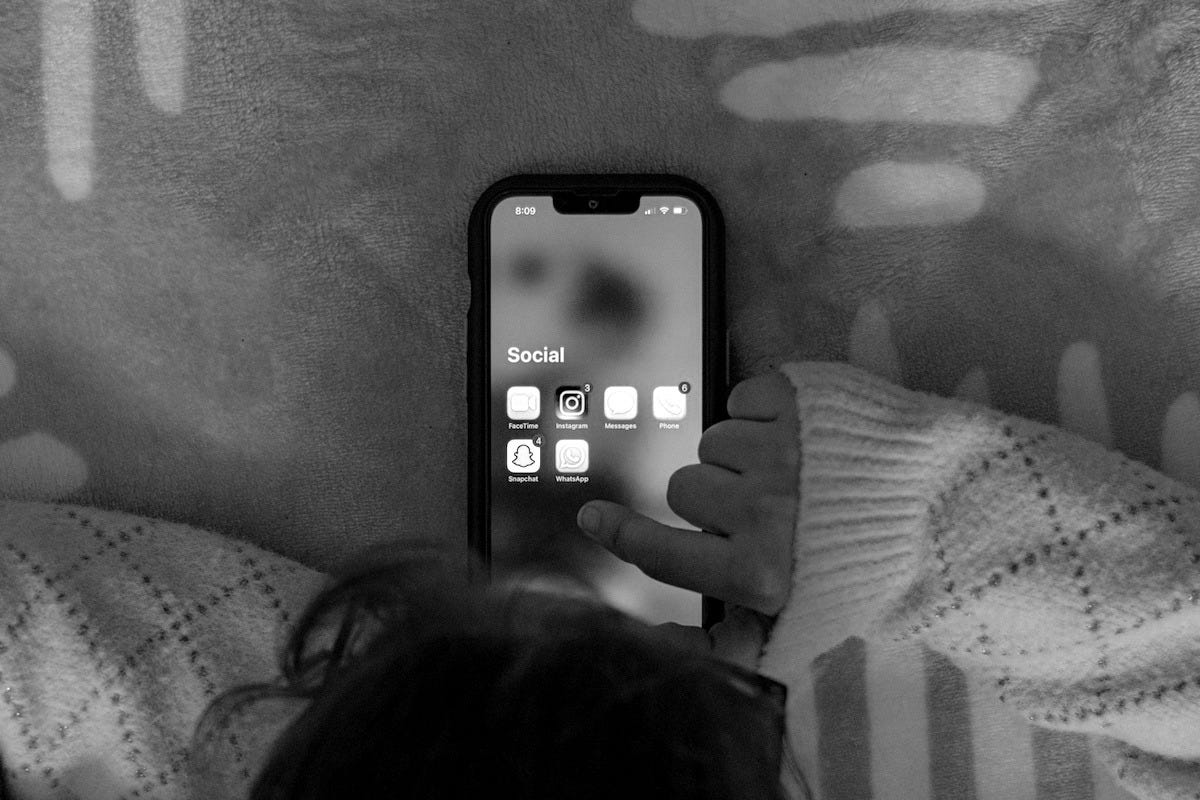
The world is slowly waking to the dangers tech poses to children. For many, the damage is done, and those responsible will be addressed too late.
Last week was a bad week for the social media giant Meta, the parent company of Facebook and Instagram. On Tuesday, a New Mexico jury found that the company had knowingly misled the public about the dangers its platforms posed and had enabled harm to its users, including child sexual exploitation, and will incur civil penalties to the tune of $375m.
“Meta executives knew their products harmed children, disregarded warnings from their own employees, and lied to the public about what they knew. Today, the jury joined families, educators, and child safety experts in saying enough is enough,” said Raúl Torrez, New Mexico’s attorney general.
State attorneys presented compelling evidence that predators often use Meta’s messaging platform because its encryption helps to hide crucial evidence of their crimes. Further, several law enforcement agencies testified concerning deficiencies in Meta’s reporting of criminal behavior within text exchanges. Internal company records also documented that several employees and outside experts had warned the company about the risks posed by Meta's platforms to children.
Origen would subscribe (maybe?)…
Ancient Christian answers for our culture’s most profound questions. Subscribe for regular articles in your inbox.
Only one day later, Meta and YouTube were found liable on all charges in a landmark ruling concerning social media addiction. The jury awarded $3 million in damages to a 20-year-old California woman, Kaley, who alleged that the social media companies hooked her when she was a young child and fed her content that led to anxiety, body dysmorphia, and suicidal thoughts. TikTok and Snap, the parent company of Snapchat, were also named in the original complaint but settled for an undisclosed amount before the trial.
In both cases, the social media giants have staunchly defended their innocence despite the overwhelming evidence against them. And yet, when questioned on Capitol Hill in 2024, Mark Zuckerberg, CEO of Meta, had to apologize when confronted by the brutal facts of the harm his platforms have caused to children across the country.
Meta and YouTube are not the only tech giants under legal scrutiny. Two weeks ago, three teenage girls, two of whom are minors, filed a lawsuit against Grok for using their pictures to generate and distribute child pornography. The pictures were then shared on a Discord server without their knowledge.
These teenagers are not the only victims. According to the Center for Countering Digital Hate (CCDH), a UK nonprofit focused on making the internet safer, Grok has generated approximately 3 million sexualized images, including 23,000 that appear to depict children. Sexualized images of children uncovered by the study included:
“A selfie uploaded by a schoolgirl was undressed by Grok, turning a ‘before school selfie’ into an image of her in a bikini. As of January 15th this post was still live on X.
An image of six young girls wearing micro bikinis, generated by Grok. As of January 15th, this image was still publicly available on X.
Four images depicting child actors.”
While the CCDH study could not always determine whether the images were generated from photos of real people, broader studies of AI image generators have found that they often are. Major nudify websites, those that turn images of real people into pornographic material, draw roughly 18.5 to 21 million monthly visits while similar mobile apps have received over 705 million downloads with an estimated $117 million in revenue.
Perhaps more alarming is that children are not only the victims of this technological leap forward, but have also been made instruments of its abuse. Many adolescents now frequently use such websites and apps. A study published earlier this month in PLoS surveyed 557 English-speaking individuals aged 13-17 and found that 55% of participants had created at least one image using nudification tools, and 54.4% had received at least one image using nudification tools. 36.3% of respondents reported having had a non-consensual image created, and 33.2% had at least one such image shared without their permission.
Nor are the problems caused by social media, AI, and other technologies confined to the United States. Poland plans to ban phone use in the classroom for children under 16. In the UK, Ofcom, the government’s communications regulator, has urged social media and gaming companies such as Meta, Snap, and Roblox to enforce the age restrictions already in their policies and adopt modern age-verification tools to keep children under 13 off their platforms. And Australia has gone further, banning social media for all children under 16, yet one-fifth of minors still use prohibited apps. Tech giants have shown little incentive and even less willpower to enforce their own age restrictions.
Indeed, even tech CEOs are now recognizing the issue. In support of the Australian restrictions and the need for some form of legal protection in the United States, Pinterest CEO Bill Ready wrote in a recent Time article,
Children today are living through the largest social experiment in history. For years, kids around the world have been given unfiltered access to social media platforms. The companies building these platforms gave insufficient forethought about the consequences, the worst of which include exposing them to unknown strangers and fueling screen addictions. This social experiment has been conducted at scale, and thus, the results are now painfully clear: rising anxiety and depression, eroding concentration, and classrooms competing for attention…. The cost of inaction is a generation of young people overwhelmed by anxiety and depression.
The tech industry has become a modern slave trader, and our children are its most valuable assets. Like slavers throughout history, it captures, trains, exploits, and profits from human beings. Nor is this some fringe misuse. These platforms are built to draw children in systematically and feed on their attention and innocence. Only when regulators force their hand do they yield any ground.
These tech giants twist everything that makes childhood beautiful into a tool for enslavement. They use children’s imagination, desires, attention, and vulnerability to bind them to the platform, extracting every last dollar through data collection, advertisements, partnerships, and premium downloadable content. And both governments and parents are letting it happen.
The child becomes a product, sold by the adults she knows to those she does not. Her presence generates engagement. Her innocence generates data. Her loneliness and insecurity generate dependence. Her image can be sexualized and circulated without her knowledge. Her vulnerability is not guarded as something sacred, but exploited as something profitable. The platform is a plantation; our children are both the slaves and the crop.
This is not merely a failed business plan or misguided corporate ethics, but a violation of the image of God in children. The Church stands resolute against the commodification of God’s image. To commodify a child’s body and soul is a sin of a different magnitude altogether. It would be better for a millstone to be tied around one’s neck than to face the judgment God has prepared for those who defile his little ones.
St. Gregory of Nyssa, a fourth-century Church Father, reminds us that slavery stands against God’s perfect plan. Whether slavery physically shackles the body or chains the soul, the commodification of humanity is a sin against God himself who made man in his image,
Tell me what sort of price you paid [for your slave]. What did you find in creation with a value corresponding to the nature of your purchase? What price did you put on rationality? For how many obols did you value the image of God? For how many coins did you sell this nature formed by God?
God said: “Let us make human beings in our own image and likeness” (Gen 1.26). When we are talking about one who is in the image of God, who has dominion over the whole earth and who has been granted by God authority over everything on the earth, tell me, who is the seller and who the buyer? Only God has this kind of power, or, one might almost say, not even God. For scripture says that the gifts of God are irrevocable (Romans 11.29).
God would not make a slave of humankind. It was God who, through his own will, called us back to freedom when we were slaves of sin. If God does not enslave a free person, then who would consider their own authority higher than God’s?1
St. Gregory saw clearly what modern CEOs and angel investors refuse to see: to treat a child as a product is not merely a social evil, but an offense against God’s just order. The child is not raw material for a platform. She is not a data point to be extracted or a target market to be exploited. And she is not a body to be manipulated and passed around online. She is made in the image of God.
That is why this fight cannot be left to lawsuits and regulators alone. Parents must regain the courage to say no to the tech giants, and to say no to their children for the sake of their happiness and safety. Christians, too, must boldly proclaim that any industry built on the monetization of children must be resisted.
The world is slowly learning. But, for some of these little ones, it is already too late.
St. Gregory of Nyssa, “In Ecclesiasten Homiliae: The Start of Homily IV,” Earlychurchtexts.com, 2025, https://earlychurchtexts.com/public/gregoryofnyss_ecclesiastes_slavery.htm.