


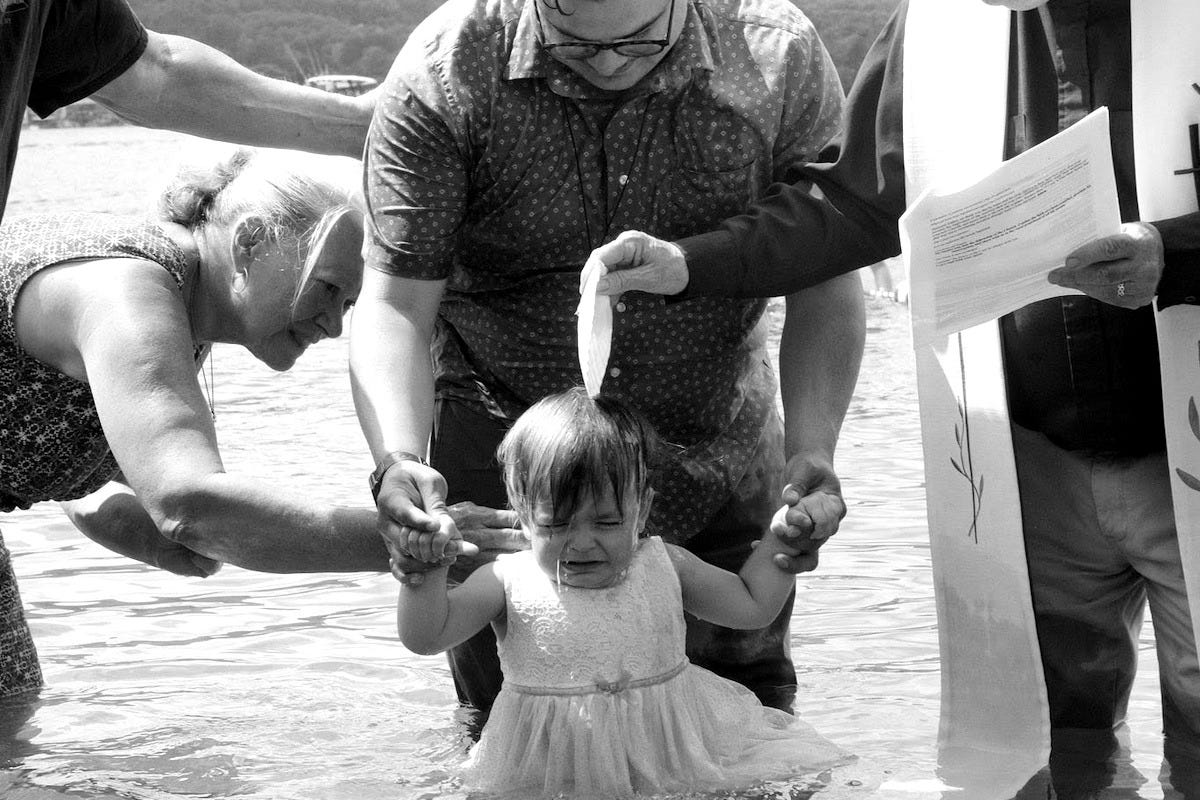
My wife and I were confirmed into Anglicanism on Trinity Sunday last year. During the past year, our children have been baptized, we have implemented morning and evening prayer in our household, and we have partaken of the weekly eucharistic services at our parish in submission to our priest and in communion with the saints. In short, we have immersed ourselves in the Anglican tradition.
And though we are still newbies, we are overly thankful to God for leading us in this direction. I’m not going to hide the ball. We love it so much that we think you should become Anglican. Especially if you are a Baptist.
It has been an interesting year, one mixed with joy and pain. Life continues regardless of which church you attend. In a year of new discoveries, we’ve also dealt with job loss and a sister’s wedding, car troubles and a birth announcement, frozen pipes and seeing family for the first time in several years. Still, time flies onward.
And yet, I’m awake. It’s past midnight here, and though I haven’t had the time between two jobs to write for a while, here I am reminiscing over our past year as Anglicans.
Perhaps a few words will be lucid.
1. The Book of Common Prayer
Bravo, English Reformers! If the Bible is the triumph of God speaking through man, The Book of Common Prayer is the triumph of man responding to God. The early separatists, in all their fervor for individual liberty before God, too quickly eschewed the rightful companion to the Good Book. And yes, The Book of Common Prayer is the proper companion to the Bible for the English-speaking world.
I don’t know how to explain the impact The Book of Common Prayer has made on me. It has completely upended the way I comprehend my devotional life. Before discovering the Prayer Book, I had developed a relatively healthy pattern of devotion. Still, it could not compare to the richness I found within the very book I was once told was a tool of the devil meant to keep God’s people from praying directly to him.
Origen would subscribe (maybe?)…
Ancient Christian answers for our culture’s most profound questions. Subscribe for a new article in your inbox every Monday.
In a prayer within, we come before God’s presence to confess our sin, “We have left undone those things which we ought to have done, and we have done those things which we ought not to have done; and apart from your grace, there is no health in us.”
Or how in one phrase of the “Phos Hilaron,” an evening hymn, is found the entire purpose of man, “You [God] are worthy at all times to be praised by happy voices…” In a few words of praise to God, we also remind ourselves every evening that our life’s purpose is fulfilled when we glorify God through our happy satisfaction in Him.
And on Sunday, we approach the very altar of God, not as husband and wife, father and son, or mother and daughter. No. As we approach the bread and wine, my wife and daughters are my sisters, and my sons are my brothers. We come together, equally heirs of God and humbly expecting to eat the same flesh of Christ and to drink his blood,
We do not presume to come to this your table, O merciful Lord,
trusting in our own righteousness,
but in your abundant and great mercies.
We are not worthy so much as to gather up
the crumbs under your table;
but you are the same Lord
whose character is always to have mercy.
Grant us, therefore, gracious Lord,
so to eat the flesh of your dear Son Jesus Christ,
and to drink his blood,
that our sinful bodies may be made clean by his body,
and our souls washed through his most precious blood,
and that we may evermore dwell in him, and he in us. Amen.
These are but a few of the jewels within The Book of Common Prayer. Don’t even get me started on The Great Litany.
Sure, I could pray words of my own making, and I still regularly do. But I find that even my personal prayers are increasingly formed by the psalms, canticles, and collects of those who came before me in both Scripture and the inheritance of Church tradition, prayers and praises that I have, through the influence of the Prayer Book, made my own. And as I pray them, my understanding is formed by the very prayers I pray. In this way, by making the prayers of the saints my own, I have grown more in my prayer life over the past year than in all years prior. To hear my children grow through the same process is a blessing upon blessings.
2. The Sacrament
I was still a Baptist pastor when Kayla and I partook of our first Eucharist at an Anglican parish in the winter before our confirmation. We knew immediately that we were on a countdown. Nothing else, not our deep study, our meetings with the man who would become our priest, or beginning morning and evening prayer as a family, made us move with as much urgency to become Anglican as partaking of the body and blood of Christ.
The culmination of the Lord’s Day, as in other liturgical traditions, is the Eucharist. Every prayer, every hymn, the confession of sin, and even the Word proclaimed in the homily prepares the flock for feeding upon Christ in the sacrament. Why? Because in receiving the bread and wine with faith, we partake of the very body and blood of Christ. Because our salvation is only possible through union with Christ, the Eucharist is a special means by which God draws us deeper into the mystery of his salvific work.
To kneel, arms outstretched and palms upward, to receive the body of Christ and feel the host within your hands. So light. It is no more than a wafer of bread. And yet so heavy. The body of Christ, broken for us. To place your lips upon the chalice and receive the wine. Sweet. Communion wine is quite sweet. And yet bitter, for it is the blood that flowed from Christ’s side. See! From his head, his hands, his feet! Sorrow and love flow mingled down, down into the chalice from which we now drink.
And to hold the truth of all this in my mind and heart as I partake with my parish. And not only with my parish, but with the whole Body of Christ in that mystical reality which knows no borders or languages. Across time, the Church Triumphant rejoices with us in its perfect union with Christ as we feast with them in the courts of heaven. The very angels sing, “Holy, holy, holy,” as we eat and drink the body and blood of their Creator.
And my children, with simple childlike faith, look up to me, “Daddy, this is Jesus’ body?” “Yes, given for you.”
3. Accountability
For you outsiders to Anglicanism, everyone in the ACNA is in an uproar at the moment over several major trials within the Anglican communion here stateside. Especially noteworthy is the trial of Archbishop Steve Wood, who was accused near the end of last year of sexual misconduct and bullying.
It’s a new world for me, and I don’t completely know what to make of it. Holding a leader accountable was never really an option before, so we’ve never had a reason to discuss the best way to do so. I don’t really understand the debates because I’ve never experienced anything like this, so I’ve mostly stayed out of it and simply asked questions. Why? Because in my Baptist times, I have personally attended multiple churches where the allegations against Steve Wood would simply have been shuffled under the carpet without recourse.
Forget trials. In the Baptist circles I inhabited, there is no way to remove a pastor other than through a physical arrest. Your only other option was to leave the church. The closest Baptists have to trials are church discipline cases contained within the local church, and those, quite conveniently, always seem to go the way the lead pastor plans they should. If you are being exploited in many Baptist churches, the response often boils down to, “Oh well. Too bad.”

I was recently reminded of this as I talked to a Baptist friend who is in bi-vocational ministry. After being beaten up and churned out by several churches, he complained to me that he felt safer at his corporate job because of its accountability structure than he did at his own church. God forbid.
No church structure guarantees that abuse will always be handled properly, and Anglicans are weak sinners, as in every other denomination. But having a canonical appeal beyond the parish priest is not only Biblical and historical, but it also adds a significant structure of accountability. If abuse occurs in my parish, the priest himself is not the final court of appeal.
That difference is significant, and its effect on my heart is stark. As a sheep of the flock, it gives me no little comfort to know that my family and I have some form of protection against spiritual exploitation if it were ever to take place, when, even in the best Baptist churches we attended, we effectively had no protection beyond the pastor. But what if the pastor is abusive? Unfortunately, that situation is all too common.
Again, lifetime Anglicans, I really don’t think many of you grasp how big of a deal this is to us Baptist and nondenominational converts. Quite candidly, I think many of you take it for granted. I have personally experienced and know of several Baptist churches that have welcomed and, in some cases, retain to this day pastors who have received overwhelmingly credible accusations of sexual abuse, domestic violence, financial impropriety, and even the molestation of children. I have watched men yell down individual teenagers from the pulpit and receive applause from the congregation.
I am overjoyed to belong to a communion of churches where the question is not whether allegations should be investigated and the guilty punished, but how best to establish the truth and administer justice while protecting the flock.
4. Heritage and Ecumenism
I don’t remember how the conversation came up, but about a year before I became Anglican, I was walking with some ministry friends when the topic of whether Catholics are Christians came up. I was confused by the question and answered, “Yes, they are Christians. Christians we disagree with on some important matters, but still Christians.”
I was surprised to find that they were radically opposed to my answer. Sure, the segmented and fractured circles I had come from thought that way, but I had expected these men, who stood outside those circles, to recognize how far the arms of God stretch forth. They told me that many Catholics they had spoken with could not explain the Gospel and believed they had to merit their way into heaven. I gave them pause when I responded that many people in our Baptist churches hold to the damnable heresy of easy-believism, yet we would still generally consider Baptists to be Christians.
The Baptist tradition is fundamentally one built upon a posture of separatism, not communion. Many Baptists see the different denominations as concentric circles. They are at the center, and the further your circle is from the Baptist one, the less likely you are to be a Christian. Presbyterians might be ok, but Lutherans and Anglicans are most often too far gone (as I have learned). Forget Catholics or the Orthodox altogether.
As an Anglican, I have been wonderfully overwhelmed by the catholicity of our tradition. I am no longer in the untenable position of doubting someone’s salvation simply because they stand further from my particular denomination. So long as they remain within the consensual tradition of the Church, I can generally regard them as brothers and sisters in the faith even if I disagree with them sharply on important doctrines.
Now, when I read the great Christian writers of ages past, I can learn from St. John of the Cross without the slightest uneasiness about whether he was “truly Christian,” any more than I would have doubted the faithfulness of St. John Bunyan of the Celestial City.
5. Some Bridges Aren’t Worth Saving
I was naive.
I thought that if we were gracious and exemplified God's love, those closest to us would be confused but willing to hear us out.
In some cases, that held true. I have several Baptist friends who will be lifelong companions and with whom I share a deep bond of brotherly love and gratitude for their faithfulness and loyalty. I also think of the Baptist church I left, whose members have only shown me the depths of God’s love since I became an Anglican. I will always be honored to have spent a brief time as one of their pastors and to have served alongside the two men who shepherded me during those years.
Others, and many more than I expected, rejected us as heretics immediately, including longtime friends and mentors. I was angry for a time. It was good for me to be angry, to bear it, to feel the weight of the sin committed against my family by many close to us, and yet to withhold speaking in anger. I am no longer angry. So now, I can speak.
While they were not the reason we converted to Anglicanism, their reactions only confirm to us that we made a wise choice to disassociate from them and their separatist influence in favor of true communion. While I did my best to preserve channels of communication and avoid burning bridges, at times it is best to recognize the relationships for what they are: unfruitful.
It is no longer fruitful to seek communion with those who have damned my wife and me to hell, those who say I am sending my children to the same place. Perhaps it was never fruitful.
Some bridges are best left to burn. I have learned to stop exerting effort to repair those bridges and leave them to burn to ash. If God so chooses to rebuild them in his time, whether in this life or in eternity, that is his prerogative, and I will receive the restoration gladly. How beautiful it is for brothers to dwell in unity! Perhaps he will. Perhaps he won’t. It is no longer my concern.
I look forward to building more fruitful bridges elsewhere.
Thank you. There is a tendency for us long-term Anglicans, and even more for British ones like me for whom it is part of the national culture, to take it for granted and grow jaded. You have reminded me of what a treasure we have. I will share this article widely. God bless.
Thank you for writing this; it really resonated with me. I’ve been attending an Anglican Church for about 6 months and it has changed my life. The Book of Common prayer has some of the most beautiful lines.