


BOURNEMOUTH, UK – An army veteran who served in Afghanistan has been convicted for silently praying outside of an abortion clinic. On Wednesday, the Bournemouth Magistrates’ Court found Adam Smith-Connor guilty of an act of “disapproval of abortion” within a “buffer zone.” He was fined £9,000 ($11,700 USD).
In the UK, "buffer zones" around abortion clinics ban any form of disapproval within 150 meters (around 500 feet) of the facility, often covering multiple streets. The law is vague about what actions are prohibited, leaving ordinary people vulnerable to legal trouble for simply offering help or expressing their beliefs.
Origen would subscribe (maybe?)…
Ancient Christian answers for our culture’s deepest questions. Subscribe for a new article in your inbox every Monday.
Years earlier, Smith-Connor had paid for his girlfriend to have an abortion. Since then, he has had a change of heart and makes frequent trips near the abortion clinic to pray for his deceased son, Jacob. To onlookers, his prayers were nothing more than a bowed head and clasped hands. He spoke no words, and he offered his prayers out of direct sight of the abortion clinic.
Smith-Connor went to his usual spot to pray on the day in question. Two police officers approached him, “What is the nature of your prayer today?” “I’m praying for my son.” Smith-Connor later recalled,
“They informed me that they considered my praying for my deceased son was a breach of the PSPO, that it was an act of disapproval of abortion, although I wasn’t manifesting that prayer in any way and, if I hadn’t told them, they would have no way of knowing what I was praying about.”
Bournemouth, Christchurch, and Poole (BCP) Council spent over £110,000 of taxpayers’ money to prosecute Smith-Connor for his victimless crime. Meanwhile, the BCP Council recently requested government assistance to prevent cutting services for special needs children, as their cities risk bankruptcy. Miriam Cates, a former member of Parliament, remarked on the trial,
“This isn’t 1984, but 2024 – nobody should be on trial for the mere thoughts they hold in their mind. It’s outrageous that the local council are pouring taxpayer funding into prosecuting a thoughtcrime, at a time where resources are stretched thin. Buffer zone regulation are disproportionately wide, leaving innocent people vulnerable to prosecution merely for offering help, or simply holding their own beliefs.”
Smith-Connor’s case is just one of many recent free speech controversies in the UK. Government censorship is a very real problem. Earlier this year, the UK dissolved freedom of the press by passing significant media regulations to curb what the government considers misinformation.
These laws also impose restrictions on journalists, limiting their ability to report content that could be seen as damaging or harmful to individuals or organizations. While these regulations may appear well-intentioned at first glance, a biased government and appointed organizations decide what is dangerous. The people of the UK can no longer rely on any local media group to report “unbiased” news.
Freedom of speech, once a hallmark of British society, has also been destroyed. For example, earlier last week, a judge sentenced Lucy Connolly, a woman with no previous convictions, to thirty-one months of prison for a tweet deemed as hate speech. The judge berated the woman during her sentencing.
The same judge allowed Anh La, who was convicted of child pornography, to walk free without any prison time. La had collected over 1000 pictures and videos over a 10-year period, 200 of which English law classifies as Category A images, or images of children that include “penetrative sexual activity, sexual activity with an animal or sadism.”
A country not founded on free speech may still thrive without it. However, when a nation rooted in free speech abandons its foundation, it opens the door to its own downfall. The Magna Carta ensured that free speech would become a central tenet in the British Isles. The UK is founded on free speech. Rejecting it is her downfall.
Free speech was birthed in a culture dedicated to Christianity and the doctrine of the imago Dei. Rejecting free speech is an expression of the UK rejecting its historical attachment to Christianity.
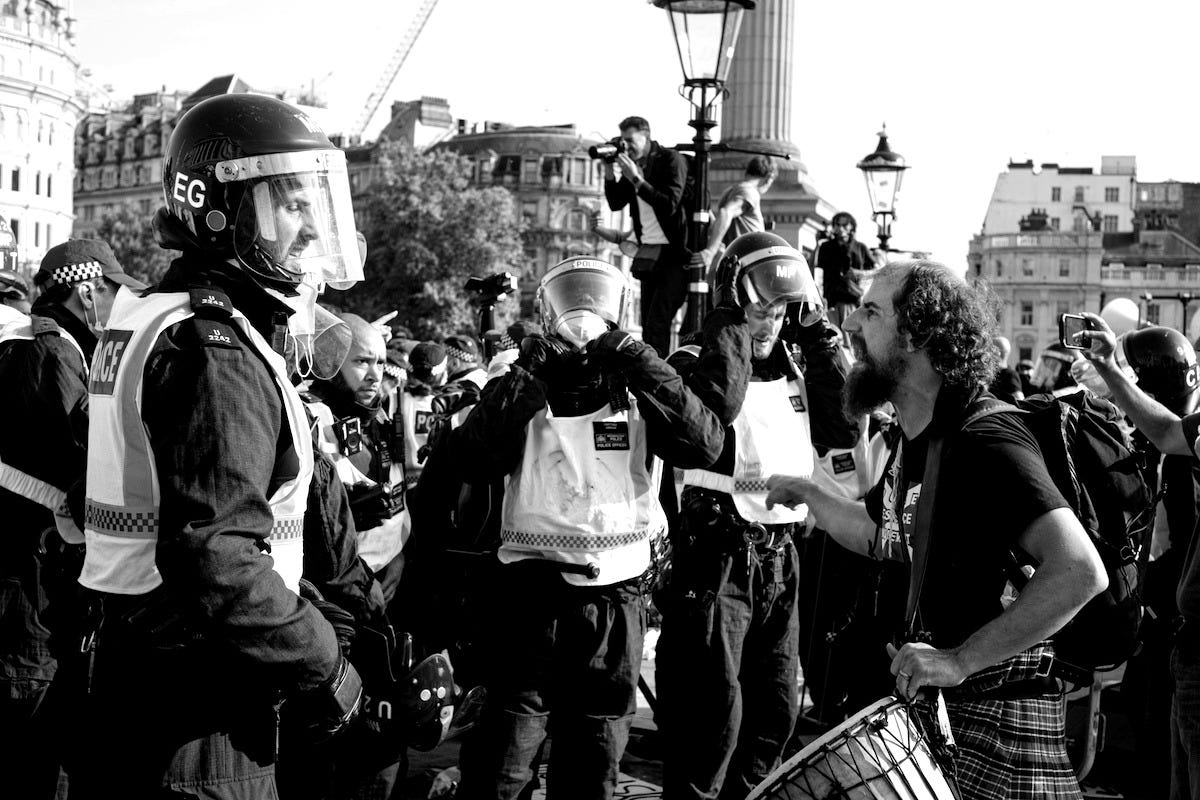
Christianity has been on a severe decline for decades in the UK. Secularism has exsanguinated the United Kingdom of its morality. In its place, an irreligious battle has ensued between secular conservatives and liberals. This battle was exemplified in the summer of this year when police and rioters clashed after a mass stabbing resulting in the deaths of three children.
The leftist government suppressed media coverage of the stabbing, withholding details from the public. Outraged by both the crime and lack of information, the public fabricated a false narrative, claiming the attacker was a Muslim immigrant. This situation highlights a deeper issue: the UK’s significant influx of Muslim immigrants, which has sparked concerns over rising violent crime, both perpetrated by and targeted against immigrants.
Even devoted atheists like Richard Dawkins are concerned over the UK’s abandonment of Christianity. In April, Dawkins appeared on LBC, a British talk radio station. Dawkins expressed his concern over the rising Muslim population in the UK and how it would affect human rights, “The doctrines of Islam…are fundamentally hostile to women, hostile to gays, and I find that I like to live in a culturally Christian country although I do not believe in a single word of the Christian faith.” In that interview, Dawkins would refer to himself as a “cultural Christian.”
Dawkins wants the fruit of Christianity without the tree. He wants the beauty of her petals without the roots. But once you lay an axe to the trunk of Christianity, so goes her fruit. The United Kingdom, once known for her enchanting churches, beautiful liturgy, and endless missionary pursuits, has dismissed Christianity and in her place invited philosophies of death.
London has fallen. We, who are her spiritual children, should mourn her loss with much self-reflection and pray for the Gospel’s rebirth in her hardened soil.
The decline of the UK mirrors the fall of Rome. Though the UK has not been physically overrun, spiritual decay inevitably precedes physical collapse. Both were once mighty empires. Both London and Rome serve as pivotal cities in Christian history. Both were destroyed from within before they were ever conquered from without.
The fall of Rome affected the early church as few other events had. When Rome fell, St. Jerome mourned for three days. To Jerome, the fall of Rome was so catastrophic as to signal the last times, “If Rome can perish, what can be safe?” Jerome laments the fall of Rome,
“I was wavering between hope and despair, and was torturing myself with the misfortunes of other people. But when the bright light of all the world was put out, or, rather, when the Roman Empire was decapitated, and, to speak more correctly, the whole world perished in one city…Who would believe that Rome, built up by the conquest of the whole world, had collapsed, that the mother of nations had become also their tomb.”1
St. Augustine likely offered the most comprehensive response to Rome’s fall in The City of God. Addressing Roman citizens who blamed the empire's collapse on abandoning pagan gods for Christianity, Augustine refuted their claims and drew a crucial distinction between the Earthly City, built by man and destined to fade, and the City of God, established by God and everlasting. For Augustine, the core difference between these cities lies in the object of their love,
“Two loves, then, have made two cities. Love of self, even to the point of contempt for God, made the earthly city, and love of God, even to the point of contempt for self, made the heavenly city. Thus the former glories in itself, and the latter glories in the Lord. The former seeks its glory from men, but the latter finds its highest glory in God, the witness of our conscience. The former lifts up its head in its own glory; the latter says to its God, My glory, and the one who lifts up my head (Ps 3:3). In the former the lust for domination dominates both its princes and the nations that it subjugates; in the latter both leaders and followers serve one another in love, the leaders by their counsel, the followers by their obedience. The former loves its own strength, displayed in its men of power; the latter says to its God, I love you, O Lord, my strength (Ps 18:1).”2
Every earthly kingdom will fail because when those who love righteousness pass, the unrighteous rise and love objects most temporal and fading. Ever-changing men found earthly kingdoms. An immutable creator built the City of God.
Rome will always fall. But God’s kingdom is an everlasting kingdom—Jesus will reign forever. Let us mourn for the UK. Let us pray for her. But let us never put our hope in any earthly kingdom. Let us find joy in our heavenly citizenship, knowing that God shall never be dethroned.
Jerome, “Prefaces to the Commentaries,” in St. Jerome: Letters and Select Works, ed. Philip Schaff and Henry Wace, trans. W. H. Fremantle, G. Lewis, and W. G. Martley, vol. 6, A Select Library of the Nicene and Post-Nicene Fathers of the Christian Church, Second Series (New York: Christian Literature Company, 1893), 500.
Saint Augustine, The City of God, ed. Boniface Ramsey, trans. William Babcock, vol. 7, The Works of Saint Augustine: A Translation for the 21st Century (Hyde Park, NY: New City Press, 2012–2013), 136–137.
As an ex-pat living in Scotland, it’s a fascinating thing to observe a culture secularizing. It has given a fresh perspective on faith to myself—to see it in contrast has helped me see it more clearly. It’s also made church community much, much sweeter! Thanks for the insightful essay