

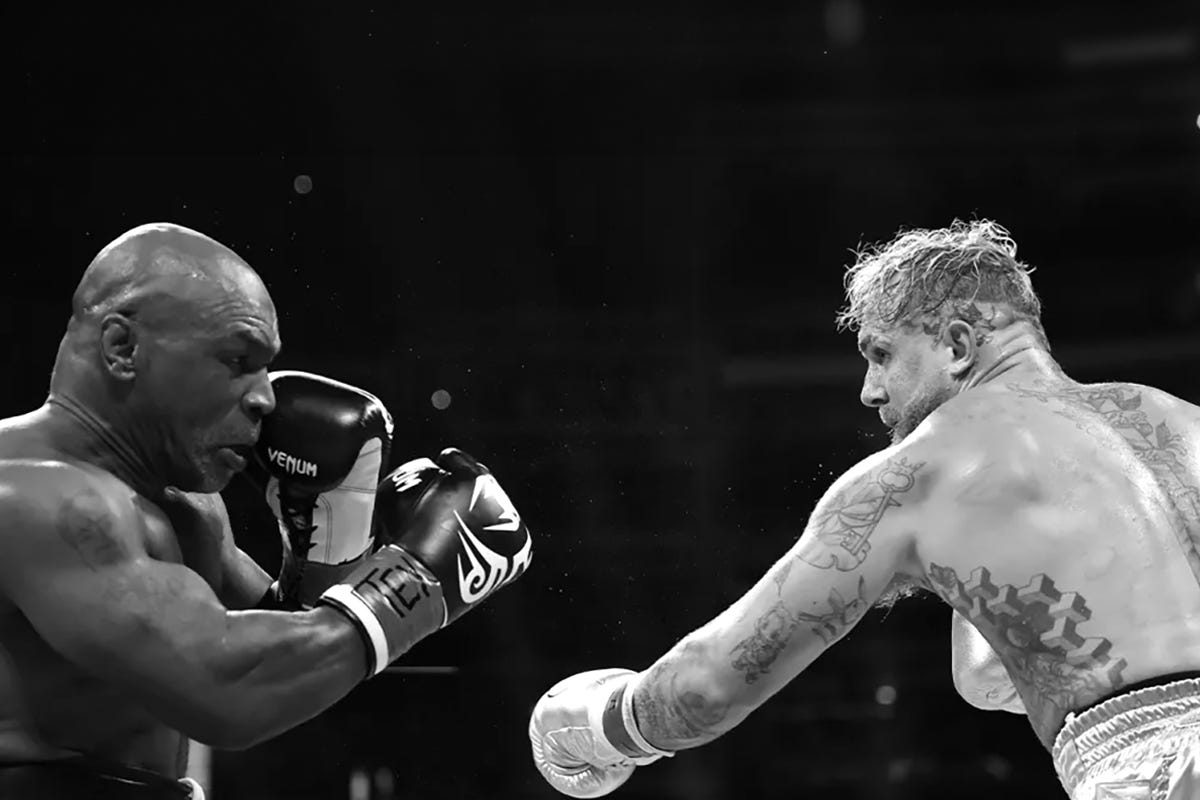
ARLINGTON, TX – Mike Tyson (58) lost in an eight-round boxing match to social media influencer Jake Paul (27) on Friday night. Tyson, a historic boxing figure known for his powerful knockouts, was inducted into the Boxing Hall of Fame in 2011 as the youngest fighter to win the Heavyweight Championship. His last professional bout was almost twenty years ago when he was defeated by Kevin McBride in 2005.
Much drama accompanied the lead-up to the fight. The usual trash-talking common to these fights commenced months ago. Even during the weigh-in, Tyson slapped Paul across the face after Paul stepped on Tyson’s toe. Because of Tyson’s legendary career and maybe because of a general distaste for Paul, Tyson was favored by many to win. For example, Drake, a Canadian rapper, placed a whopping $355,000 bet on an Iron Mike win.
Per all three judges, Paul’s victory was unanimous by a large margin. “Let’s give it up for Mike,” Paul said before the decision was announced. “He’s the greatest to ever do it. I look up to him. I’m inspired by him.” Boos from the leaving crowd accompanied the announcement of Paul’s victory. Paul later told a reporter, “I wanted to give the fans a show, but I didn’t want to hurt somebody that didn’t need to be hurt.”
Origen would subscribe (maybe?)…
Ancient Christian answers for our culture’s deepest questions. Subscribe for a new article in your inbox every Monday.
Given the significant age gap, the outcome was hardly surprising. In his prime, Tyson would have pummelled Paul without breaking a sweat. But nearing 60, Tyson appeared fatigued as Paul methodically accumulated points against the legendary fighter. Spectators in the arena were frustrated by the fight's sluggish pace, while viewers at home grew even more annoyed by Netflix’s frequent server lags as the streamer tried to support a record-breaking number of watchers.
Two days before the fight, Mike Tyson met with 14-year-old journalist Jazlyn Guerra for an interview. The exchange quickly went viral, thanks to Tyson’s unexpected responses. When Guerra asked what kind of legacy he hoped to leave after the fight, the legendary boxer delivered answers that caught the young journalist and many viewers off guard. Tyson responded,
“I don’t believe in the word legacy. I just think it’s another word for ego. Legacy doesn’t mean nothing. That’s just some word everyone grabbed onto. Someone said that word and everyone grabbed on to it and now it’s used every five seconds.
It means absolutely nothing to me. I’m just passing through. I’m going to die and it’s going to be over. Who cares about legacy after that? What a big ego. I want people to think I’m this, I’m great. No, I’m nothing. We’re just dead. We’re dust, we’re absolutely nothing. Our legacy is nothing.
Can you really imagine somebody saying ‘I want my legacy to be this way when I’m’? You’re dead! You think someone really wants to think about you?
As the 70s band Kansas so eloquently put it, “All we are is dust in the wind.” Solomon echoes this in Ecclesiastes: “All go to one place. All are from the dust, and to dust all return.” Tyson’s overly somber response to a 14-year-old’s innocent question created a moment of unintended comedy, yet it also carried an important truth.
Likely reflecting on his age and mortality, Tyson’s words—and his performance in the ring—remind us of life’s fleeting nature. We age. Our youth fades. Our strength diminishes. Eventually, death comes for us all. Such is life. As the Stoics and later Christians would say, Memento Mori—remember your death.
Yet Tyson is mistaken in one regard. While we will all face death and may be forgotten by history, no victory or defeat is lost in the timelessness of eternity. Legacy matters because God remembers, even if the generations after us do not. And God is eternal. Therefore, our brief lives carry the potential to leave an everlasting memorial, written not in the annals of human history but in the memory of the divine.
One such saint who left a lasting legacy is St. Anthony the Great, a monk who lived during the late 3rd and early 4th centuries. Known as the “Father of Monasticism,” Anthony abandoned his life of comfort for a life of prayer and study in the harsh Egyptian desert. His dedication to prayer, fasting, and solitude inspired countless others to pursue the monastic life, shaping the spiritual practices of Christianity for generations. In addressing a group of his students, Anthony exhorts,
“To begin with, let us all have the same zeal, not to give up what we have begun, not to lose heart, nor to say: ‘We have spent a long time in this asceticism.’ No, beginning over each day, let us increase our zeal. The whole of man’s life is very short measured by the ages to come, so that all our time is as nothing compared to eternal life. And in the world everything is sold at its worth and like value is bartered for like; but the promise of eternal life is bought for very little.
For Scripture says: The days of our life have seventy years in them; but if in the mighty they are eighty years and more, they are a labor and a burden. If, then, we live the full eighty years, or even a hundred, in the practice of asceticism, we shall not reign the same period of a hundred years, but instead of the hundred we shall reign for ever and ever. And though our striving is on earth, we shall not receive our inheritance on earth, but what is promised us is in Heaven. Moreover, we shall put aside our corruptible body, and receive it back incorruptible.”1
While most of us are not devoted to asceticism, Anthony’s words ring true even in simple everyday Christian obedience. Tyson’s and St. Anthony’s responses highlight two differing views of legacy—one rooted in despair and the futility of human efforts, the other in hope and the eternal perspective of God’s promises.
To Tyson, all human ambition is merely dust in the wind. To Anthony, that same human ambition may become an eternal memorial when dedicated to God. Both remind us of our mortality, but only Anthony offers a path forward—a life lived in the shadow of eternity, where even the smallest acts of faithfulness echo forever.
As we reflect on Tyson’s lament and the inevitability of death, the question remains—what kind of legacy are we building? Is it one consumed with the applause of men or one forged in the quiet faithfulness of lives lived for God? Tyson may dismiss legacy as a construct of ego, but Scripture reminds us that our lives, though brief, can serve a greater purpose. In Christ, even dust in the wind can be redeemed into something with eternal impact.
In God, nothing is wasted. The victories and defeats of this life, whether in the boxing ring or the solitude of prayer, are seen and remembered by the One who redeems all things. Even as we age, as all must, may we live with eternity in our sight and purpose in our steps. Only then will we leave a legacy worth remembering.
St. Athanasius, St. Athanasius: The Life of Saint Antony, ed. Johannes Quasten and Joseph C. Plumpe, trans. Robert T. Meyer, vol. 10, Ancient Christian Writers (New York; Mahwah, NJ: Newman Press, 1978), 34.
Thank you very much for this.